





story
Kanakaraju (Varun Tej), a traditional Chekka Bhajana performer from Penugonda, falls in love with Chaitra, an employee at the Kia factory. Along with his photographer friend Kittappa (Satya), he keeps following Chaitra in an attempt to impress her. Chaitra, however, dreams of settling down in South Korea. Meanwhile, Kanakaraju frequently clashes with local politician Chenga Reddy (Sunil) and his nephew Curry Srinu (Temper Vamsi).
During a bar fight, Kanakaraju suddenly gets possessed by the spirit of a Korean man, turning his life upside down. Due to a series of unexpected circumstances, Kanakaraju, Kittappa, and Chaitra eventually travel to South Korea. What happens there? Whose spirit possesses Kanakaraju? Who killed the Korean man? The answers to these questions form the rest of the story.
Analysis
Although the makers promoted Korean Kanakaraju as a horror comedy, the film also packs a significant amount of action. Director Merlapaka Gandhi attempts to balance horror, comedy, and action, but the execution falls short of delivering a consistently engaging entertainer.
The first half begins with a routine love story. The film gains momentum only after Kanakaraju becomes possessed by the Korean spirit. The dog sequence and Satya’s comedy provide genuine laughs, while the interval twist is decent, though not particularly fresh.
The entire second half is set in South Korea, where the mystery surrounding the spirit’s identity and backstory unfolds alongside the “21-day condition.” However, this portion loses momentum. The action sequences feel unnecessarily stretched and forced. Scenes like Bulliraju’s glass doll sequence and the gangster bloodbath in Korea add little value to the narrative and could have been omitted without affecting the story. The climax also ends on a rather underwhelming note.
Performances
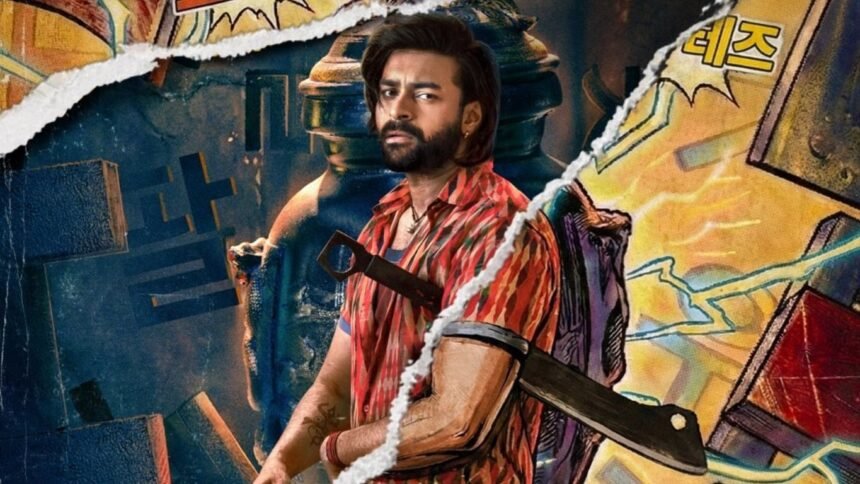
Varun Tej plays a character with two distinct shades. He delivers a satisfactory performance as Kanakaraju and looks stylish in the role of the Korean gangster. His action sequences are impressive, although such large-scale action doesn’t seem necessary for this story.
Satya emerges as another major highlight of the film. His portrayal of Kittappa generates most of the laughs, providing much-needed comic relief throughout the movie.
The actress playing Chaitra delivers a routine heroine performance. Murali Dhar Goud appears in a role that significantly influences the storyline. Sunil and Temper Vamsi are largely confined to the first half, while Srinivas Avasarala plays a familiar mysterious character.
Technical Aspects
Director Merlapaka Gandhi picks an interesting concept but doesn’t execute it effectively. Several logical gaps remain unresolved, and the screenplay follows a predictable pattern. The reason behind the Korean villain’s death also lacks the emotional or dramatic impact needed to engage the audience.
Thaman’s songs are decent, while the background score works well. The editing could have been sharper, reducing the runtime and making the film more gripping. The visuals are appealing, and the production values are adequate. However, much of the second half unfolds in what appears to be almost the same building location, making the visuals feel repetitive.
Verdict
Korean Kanakaraju offers a few entertaining moments, particularly through Satya’s comedy and some horror elements. However, the routine screenplay, weak second half, unnecessary action episodes, and lackluster climax prevent it from becoming a fully satisfying horror-comedy. If you’re willing to overlook the logical flaws, the film manages to entertain in parts
Rating: 2.50/5




Finally found a reliable link that actually works. The slots are exciting and the bonuses are generous. I’m having a great time here. Check bigslot288link
Love how quick it is to get into the action here. No more endless waiting or broken links. Just a smooth ride with temposlotlogin every single time.
I really love the bonuses they offer for new players. It gave me a great head start to try out different slots. winbrl01 is the way to go.